

Processor selection shapes everything that follows in smart device development. Performance, power consumption, connectivity, security and scalability all trace back to decisions made early in the design process.
Modern Internet of Things (IoT) and Edge computing devices keep raising the bar. Capabilities that once defined premium products, such as artificial intelligence (AI) inference and wireless connectivity, now appear across entire product categories.
Engineering teams know the technical requirements. Where things get complicated is balancing those requirements against business realities. So how do you make the right choice?
The first step is to have a structured evaluation framework that aligns processor capabilities with the application's needs. With this embedded processor selection guide, it's easier to make the right choice from the start and set products up for success.
Embedded Processors for Smart Devices
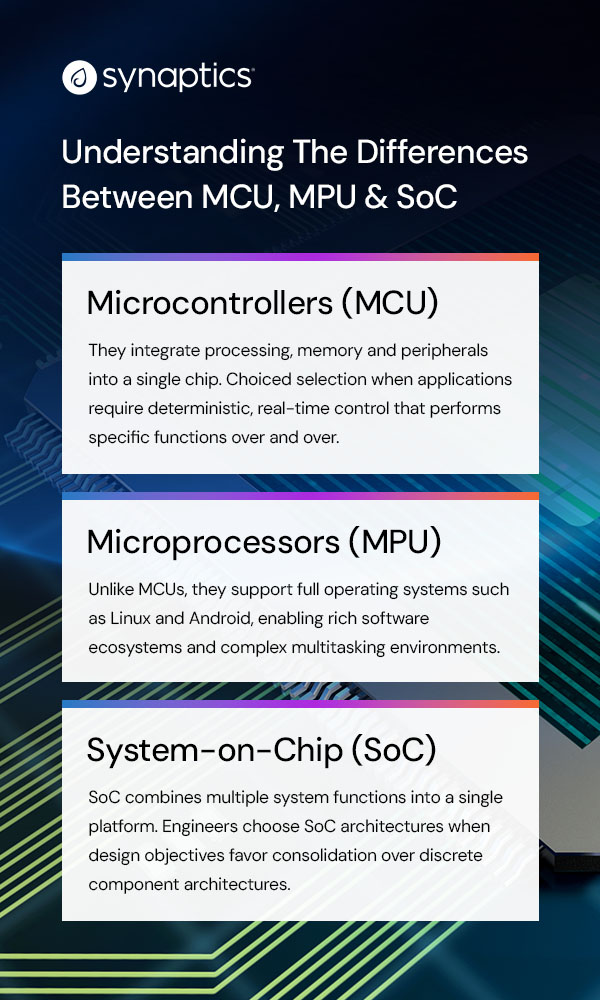
Choosing the right embedded processor begins with understanding the differences between microcontrollers (MCU), microprocessors (MPU) and system-on-chip (SoC). Each architecture supports different performance levels, power requirements, software environments and integration capabilities that influence how devices function, develop and scale.
Microcontrollers for Dedicated Tasks
Microcontrollers integrate processing, memory and peripherals into a single chip. Design engineers choose MCUs when applications require deterministic, real-time control that performs specific functions over and over.
Key characteristics of MCUs are:
- Self-contained architectures
- Lower power consumption
- Reduced bill of materials (BOM) costs
- Simplified development environments
- High reliability for single-purpose applications
Advantages of using MCUs include:
- Predictable performance patterns
- Battery-friendly operation
- Cost-effective implementation
- Straightforward integration
- Proven reliability across deployments
MCUs are found in devices like smart thermostats, environmental sensors, health monitoring wearables, smart home automation devices and industrial monitoring systems.
Applications requiring advanced operating systems, multimedia processing or large-scale AI workloads push beyond MCU capabilities. For these use cases, teams need more computational headroom and software flexibility.
Microprocessors for Complex Operations
Complex operations work better with microprocessors as they prioritize computational flexibility and software sophistication. Unlike MCUs, these microprocessors support full operating systems such as Linux and Android, enabling rich software ecosystems and complex multitasking environments.
MPUs feature:
- Full operating system support
- External memory and peripherals
- Greater computational flexibility
- Complex networking stacks
- Advanced graphical interfaces
- Rich software ecosystems
Typical applications include:
- Smart displays with touch interfaces
- Industrial gateways managing multiple protocols
- Robotics systems with vision processing
- Connected appliances running apps
- Human-machine interfaces with rich graphics
Software requirements often determine architectural suitability before hardware specifications are considered. Operating system compatibility constraints can narrow down processor options early, as teams must consider not only current software needs but also future application requirements.
SoC for Maximum Integration
SoC combines multiple system functions into a single platform. Engineers choose SoC architectures when design objectives favor consolidation over discrete component architectures.
The benefits of SoC integration include:
- Simplified hardware development
- Lower BOM costs
- Smaller device footprints
- Improved power efficiency
- Decreased inter-chip communication overhead
Common integrated subsystems include:
- Application processors
- Microcontroller cores
- Memory controllers
- Connectivity subsystems
- Graphics engines
- Specialized accelerators
Smart home devices, industrial equipment, connected displays and advanced IoT products often benefit from strong integration. But not every application needs maximum consolidation.
Engineering teams should evaluate integration levels against specific application requirements rather than assuming that more integration always delivers better outcomes. Some designs perform better with discrete components that allow independent optimization of subsystems.
Key Evaluation Criteria for Embedded Processors
After identifying the appropriate processor category, engineering teams face the challenge of evaluating the factors that determine real-world performance and product success. Selection criteria should address application requirements, power budgets, AI workloads, connectivity needs, security posture and future expansion plans.
Performance Alignment With Application Needs
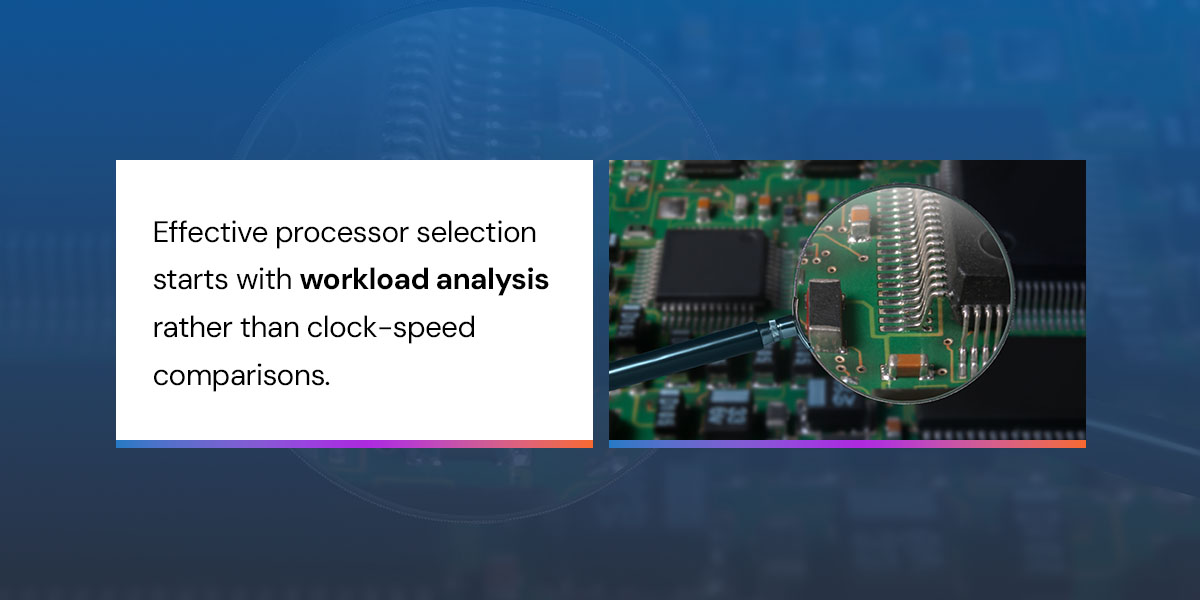
Effective processor selection starts with workload analysis rather than clock-speed comparisons. Processing requirements vary significantly by application, and embedded processor performance metrics must align with operational demands.
Consider the following critical evaluation criteria:
- Core architecture selection
- Core count requirements
- Memory bandwidth needs
- Hardware acceleration capabilities
- AI inference performance
- Multimedia processing capacity
Dedicated accelerators improve efficiency for specialized workloads like audio processing, graphics rendering and machine learning capabilities. Capable multimedia processing solutions become more important for smart displays, vision systems and collaboration devices that handle video streams and complex visual interfaces.
The gap between general-purpose compute and specialized acceleration often determines whether a design meets performance targets within power budgets. Matching processor capabilities to applications improves efficiency while controlling costs.
Power Consumption for Low-Power Embedded Processors for IoT
Power consumption affects battery life, thermal performance and product size. Engineering teams should focus on performance per watt rather than maximum processing power when evaluating low-power embedded processors for IoT applications.
Factors that affect power include:
- Active-state consumption patterns
- Sleep-state efficiency
- Wake-up performance characteristics
- Dynamic power management capabilities
- Peripheral power-control options
Wearables and remote sensors spend most of their operational life in low-power states. Efficient architectures support longer battery life without sacrificing responsiveness when active processing becomes necessary.
Power optimization becomes more important as AI workloads move closer to the Edge, as local inference can consume significant energy.
Architecture choices made during processor selection become even more critical because they establish power envelopes that software optimization alone can't overcome. The gap between software-based inference and hardware-accelerated approaches often determines whether a battery-powered IoT device runs for days or months between charges.
Integrating AI and Machine Learning Capabilities
Evaluate AI capability based on application requirements rather than treating it as a mandatory processor feature. Engineering teams benefit from first determining whether machine learning improves device functionality or user experience before selecting AI-enabled embedded processors.
Ask these evaluation questions:
- Does the device require real-time decision-making?
- Does the application benefit from local inference?
- Does network availability remain inconsistent?
Workloads that benefit from embedded AI include:
- Voice recognition and command processing
- Object detection and classification
- Predictive maintenance algorithms
- Sensor fusion and data correlation
- Anomaly detection patterns
Once the AI requirements become clear, processor architecture takes center stage. Hardware acceleration reduces power consumption compared to CPU‑only or software‑only inference, so teams can't afford to neglect hardware choices. On-device AI can improve responsiveness, reduce cloud dependency and support more-efficient operation at the Edge.
AI-enabled embedded processors deliver the most value when intelligence, efficiency and low latency contribute to product objectives. Teams should evaluate AI performance using their target workloads rather than synthetic benchmarks that may not reflect real-world requirements.
Ensuring Robust Wireless Connectivity and Sensor Integration
Integrated wireless connectivity solutions simplify development compared to discrete radio modules, resulting in a more streamlined process from the drawing board to product launch.
Connectivity technologies that may play a role in device development include:
- Wi-Fi for high-bandwidth applications
- Bluetooth Low Energy (BLE) for efficient short-range communication
- Thread for mesh networking
- Matter for smart home interoperability
- Ethernet for wired industrial connections
Beyond wireless protocols, processor selection should account for sensor integration requirements. General-purpose input/output availability, inter-integrated circuit support, serial peripheral interface capabilities, universal asynchronous receiver-transmitter channels and analog input options determine how processors connect to the physical world.
Wireless connectivity solutions make the design process easier while supporting modern Edge applications. Connectivity plays a central role in Edge AI deployments and applications because intelligent devices depend on reliable data movement between sensors, processors and other system components. Integrated connectivity reduces board space, simplifies certification and improves signal integrity compared to discrete wireless modules.
Implementing Security Measures for Embedded Processors
Security evaluations should happen at the processor level rather than being added later through software patches. Hardware security establishes trust throughout the device life cycle, and secure embedded processors for IoT provide foundational protection that software alone can't match.
Important security capabilities include:
- Secure boot processes
- Hardware root of trust
- Cryptographic accelerators
- Secure key storage mechanisms
- Trusted execution environments
- Secure firmware update channels
Security architecture protects multiple assets:
- User data and privacy
- Device integrity and authenticity
- Intellectual property and algorithms
- Network communications and credentials
Strong security capabilities support regulatory compliance and long-term product viability. Connected devices now require hardware-level protection to address evolving cybersecurity threats that target vulnerable points. Without robust security, many devices won't make it to market.
As cybersecurity constantly evolves, hardware-based solutions are more valuable as attack surfaces expand and threat actors develop new exploitation techniques. Embedded processors offer a higher level of privacy because processing data on the device keeps sensitive information local, rather than transmitting it to remote servers where interception is possible.
Planning for Scalability in Edge Computing Embedded Processors
Processor selection should support future product generations alongside current requirements. Edge computing embedded processors face expanding demands as AI workloads become more sophisticated and application expectations rise.
Critical evaluation criteria include:
- Pin compatibility across product families
- Software portability between generations
- Common development environments and tools
- Long-term product availability commitments
- Vendor roadmap visibility and alignment
Shared software frameworks improve development efficiency across product families. Code developed for one device can migrate to higher-performance variants as product lines expand or requirements evolve.
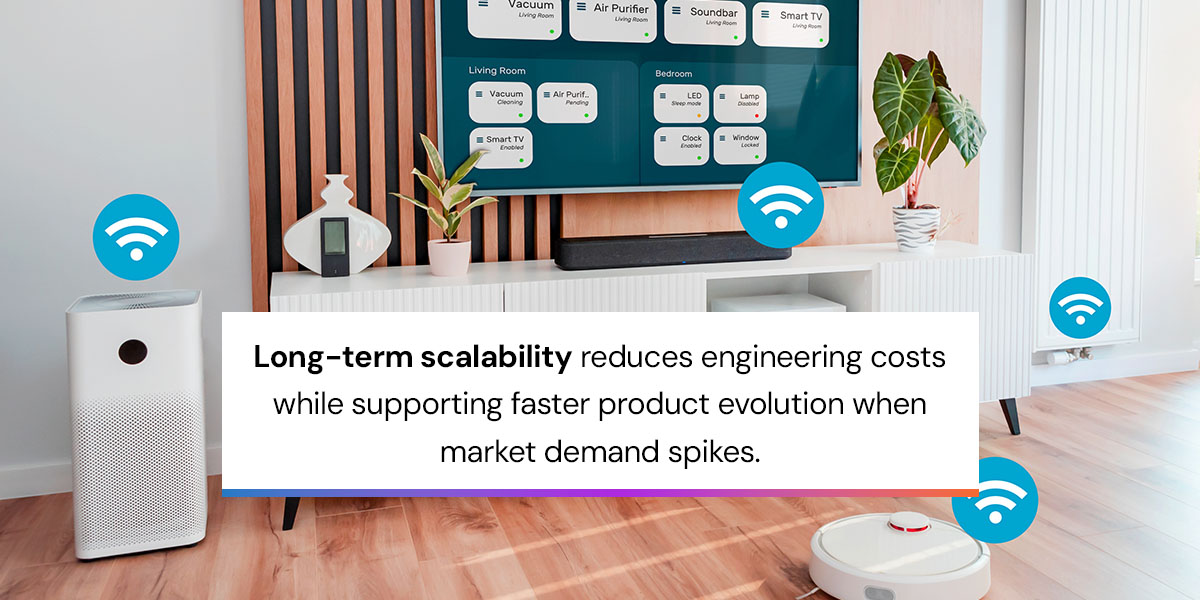
Long-term scalability reduces engineering costs while supporting faster product evolution when market demand spikes. Maintaining platform consistency allows teams to reuse drivers and application code across multiple products, reducing time-to-market for derivative designs.
Developer kits and other software tools also accelerate development cycles and simplify migration between product generations.
Processor Selection by Smart Device Application
Processor requirements vary depending on the smart device's intended application. Evaluating by application-specific criteria helps teams align resources, features, power efficiency and security capabilities with the operational demands of the product.
Embedded Processors for Smart Cameras and Vision Systems
Smart security cameras process large volumes of visual data in real time. Their capabilities require balanced performance across multiple domains rather than optimization for a single metric.
Critical capability areas include:
- AI processing for analytics
- Image signal processing for quality
- Multimedia acceleration for encoding
- Connectivity for data transmission
Common vision workloads include:
- Object recognition and tracking
- Facial recognition and authentication
- Occupancy monitoring and analytics
- Industrial inspection and quality control
Local AI processing improves response times and reduces reliance on the cloud. Image quality and analytics performance depend on dedicated vision processing resources that handle pixel pipelines, noise reduction and real-time enhancement.
High-performance embedded processors support advanced Edge analytics while maintaining the power efficiency necessary for continuous operation. Vision applications often require sustained processing throughput rather than burst performance, making thermal design and power efficiency critical selection factors.
Processor Selection for Wearables and Power-Sensitive Devices
Wearables operate under strict battery, thermal and size constraints. Processor selection for wearables should prioritize characteristics that extend operational life while fitting within compact form factors.
Essential requirements for wearables include:
- Ultra-low power operation modes
- Small package dimensions
- Integrated connectivity options
- Efficient sensor-management capabilities
Continuous sensing workloads require careful power management. For example, health-monitoring devices depend on reliable sensor integration and wireless communication to deliver meaningful data without draining batteries within hours.
Bluetooth Low Energy remains a common connectivity requirement for wearables that sync data to smartphones and other devices. Strong integration helps reduce board size while extending battery life through optimized power and sleep modes.
Wearable designs must balance always-on sensing requirements with battery constraints that limit average power consumption to microamperes rather than milliamperes.
Industrial IoT Embedded Processors and Robotics Solutions
Industrial environments require reliability, security and predictable operation under challenging conditions. Embedded processors in this field often combine Edge processing with cloud connectivity to support both local control and centralized management.
Important requirements for industrial processors include:
- Real-time responsiveness for control loops
- Security protections against industrial threats
- Operational life spanning years
- Wide temperature support for harsh environments
- Reliable networking under interference
Robotics applications require low-latency processing and precise control that meet deterministic timing requirements. AI now supports more predictive maintenance algorithms and machine vision workloads that identify defects and optimize operations.
Long-term platform support remains important because industrial deployments often remain operational for many years. Component availability and vendor commitment to sustained production determine whether designs remain in service or require expensive redesigns when processors reach end-of-life.
Partner With Synaptics for Advanced Embedded Processing Solutions
Processor selection comes down to balance. Engineering teams must evaluate multiple factors while meeting aggressive timelines and controlling costs. Any one factor can derail a product if the underlying architecture doesn't support it.
Modern smart devices benefit more and more from integrated platforms that consolidate compute, AI acceleration, wireless connectivity and multimedia processing. Fragmented approaches create integration challenges, extend development cycles and introduce failure points that surface late in the process.
Synaptics Astra® is an AI-native platform built with precision for Edge intelligence. Scalable processor options support everything from simple sensing devices to sophisticated vision systems.
Hardware-accelerated AI inference runs with efficiency at the Edge. Integrated connectivity solutions reduce design complexity, and security capabilities built into the silicon protect devices throughout their operational lives.
Contact us today to explore how our Astra embedded processing solutions support your next smart device development.