
As the smart home market matures, consumers demand devices that are not just connected, but intelligent and interoperable. It can be a challenge to address their demands because original equipment manufacturers (OEMs) face regulatory changes affecting new security, efficiency and data laws that make legacy hardware obsolete. Key technologies like Matter, edge AI and multimodal sensing can solve these challenges.
Explore the key architectural shifts you need to make to thrive in the next generation of smart home connectivity developments.
The New "Must-Haves" for Smart Home OEMs
The era of the single-function chip is over. To compete, a smart home device must handle connectivity, artificial intelligence (AI) and security simultaneously. A few years ago, a smart bulb with a Wi-Fi radio was enough to satisfy users. Now, users want their smart bulbs to be compatible with Siri and Alexa and minimize battery drain. These issues are not only driven by consumer demand, but also by regulatory forces. These forces are turning nice-to-have features into legal requirements for market entry.
The key regulatory areas that affect bill of materials (BOM) costs include:
- Interoperability: Devices must be able to connect with one another. EU mandates such as the Data Act are forcing open ecosystems. OEMs have to abandon proprietary, low-cost radios for more-complex, multi-protocol silicon.
- Security: At the same time, the United States National Institute of Standards and Technology (NIST) guidelines are raising the bar for hardware protection and security. You can't solve these with a software patch, as it requires changes to the hardware itself.
- Efficiency: Another key regulatory change is the Energy Star® Smart Home Energy Management System (SHEMS) program's demand for precise, AI-driven power management, such as occupancy sensing. Your products have to move beyond simple timers and instead detect when a room is empty, using always-on sensing while minimizing power consumption.
Matter Is Now the Universal Language
Interoperability in smart home devices spells the end of the walled-garden approach to creating proprietary devices that lock into exclusive ecosystems. Under Article 33 of the EU Data Act, devices must share data easily. Proprietary clouds that lock users in are becoming harder to sell in Europe.
The key solution here is Matter, which ensures compliance out of the box through its universal, open-source connectivity. Your silicon must speak Matter natively, running locally on the home network to bolster speeds and reliability. Instead of building separate products for Alexa or HomeKit, you build one Matter version that works everywhere across devices. Previously, OEMs had to manage stock-keeping unit (SKU) proliferation, which multiplied manufacturing and inventory costs by the number of devices required for each brand.
Using Matter does pose one key challenge, though. Matter requires Thread, Wi-Fi and Bluetooth to run simultaneously. A modern device cannot just use one of these radios. It needs the best wireless protocols for smart home connectivity to work together:
- Wi-Fi for high-bandwidth data, such as video streams or firmware updates
- Thread as a low-power mesh for small packet data, such as sensor readings and light commands
- Bluetooth LE for initial commissioning
As all three of these radios operate on the 2.4 gigahertz spectrum. Without advanced filtering, they shout over each other. The result is packet loss and lag. For example, if a Wi-Fi radio is streaming 4K video, it floods the 2.4 gigahertz band. If a Thread sensor attempts to send an unlock-door command at the same time, the signals collide and are lost. Users then experience latency spikes, like pressing a button and a light having a two-second delay because the radio had to retry the transmission too many times to be efficient.
Matter also allows for multi-admin control. A smart home user can control their device across Apple, Google, and Amazon products without complex re-pairing. For OEMs, this helps to reduce return rates caused by ecosystem incompatibility. Lower return rates eases the burden on customer support teams in troubleshooting connectivity issues.
Another challenge is that using three chips for each radio also wastes board space and makes synchronization nearly impossible. Even with three chips, there will still be milliseconds of lag due to communication over conductive paths on the board they're mounted on.
The key solution is upgrading the hardware to a chip that manages it all. Placing the radios on the same die means arbitration happens in nanoseconds, preventing collisions.
The Role of Edge AI in Smart Home Automation
While connectivity in smart home devices provides the pipe for data, intelligence is the key to addressing some of the inefficiencies of legacy smart home tech. Cloud-based AI solutions are failing because of latency issues. When voice assistants take two seconds to respond because they have to go to the cloud first, it takes too long. Instead, users expect quicker response times. In human-computer interaction, users expect a delay of no more than 200 milliseconds (ms) as this begins to feel sluggish and breaks any illusion of seamlessness. For voice commands or real-time security alerts, this is pivotal.
The role of edge AI in smart home automation is taking out the step of going to the cloud. This produces faster response times as the processing happens locally on the device.
Another benefit of edge computing in smart home tech is privacy. Rather than streaming video 24/7 to the cloud, edge AI enables smart home cameras to process video on the device. This also means OEMs can reduce their compliance burden under the General Data Protection Regulation (GDPR) and the California Consumer Privacy Act (CCPA) by keeping personally identifiable information, such as facial data, on the device.
To qualify for utility rebates under Energy Star SHEMS certification, devices must reliably detect occupancy. Legacy tech, such as simple motion sensors using passive infrareds (PIRs), fail when a user is sitting still, such as reading a book. This causes the lights to turn off, frustrating the user who still needs the light. By using local neural processing units (NPUs), edge AI uses radar or Wi-Fi sensing to detect presence. Radar or Wi-Fi channel state information detects Doppler shifts, such as heartbeats and breathing movements, without the need for a camera. The smart home device stays on when the user is in the room, and turns off when they leave. In this way, edge AI combines precision with privacy, something legacy AI tech can't do.
The Rise of Multimodal Sensing: Voice, Vision and Touch
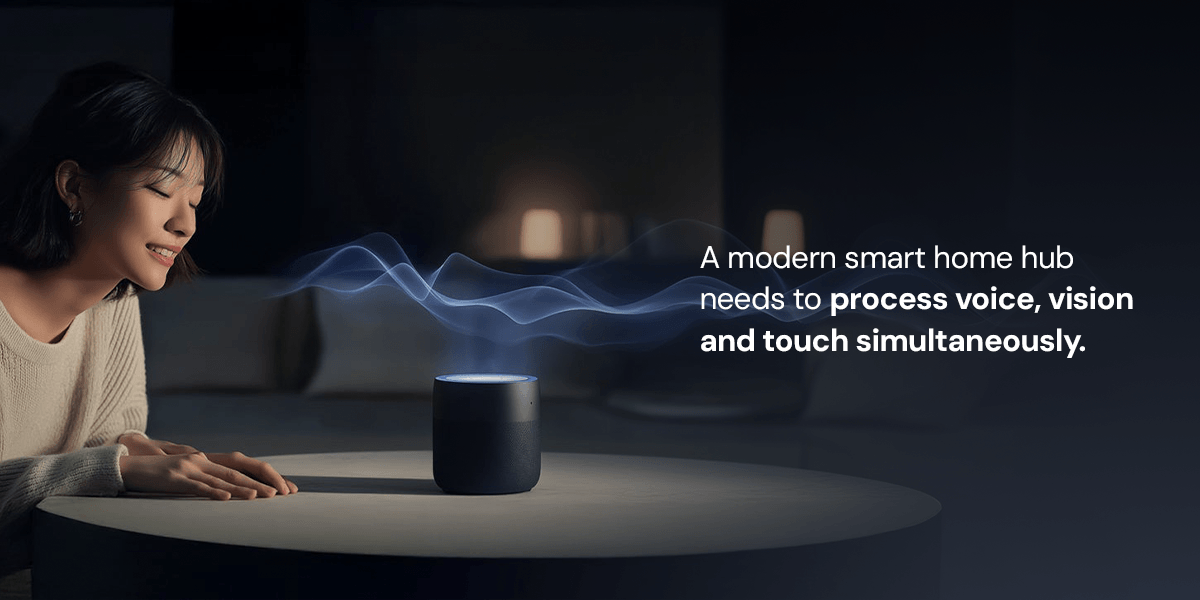
The rise of multimodal sensing is another way in which the Internet of Things (IoT) is shaping the future of smart homes. In the ambient home, devices are no longer just speakers or screens. A modern smart home hub needs to process voice, vision and touch simultaneously. It does this through sensor fusion, in which devices combine their inputs to make a decision. A smart thermostat with sensor fusion uses a camera to identify who entered the room and their preferred temperature. It also uses radar to confirm they are in the room. Finally, it uses the audio function to hear the command to make the room cooler. Using these inputs, the thermostat delivers a personalized result and a comfortable temperature for the user.
But sensor fusion increases processing burden. Standard microcontroller units (MCUs) can't efficiently run a wake-word engine, face recognition and a touch interface at the same time. Legacy MCUs are serial processors, so if the chip is 100% utilized for analyzing a video frame for facial recognition, it effectively stops listening for voice commands. This makes the user repeat themselves before the device even hears them, creating a frustrating experience.
The solution for multimodal sensing is a heterogeneous compute. These chips have dedicated engines for audio, video and AI, so the main central processing unit (CPU) doesn't get bogged down. Crucially, it enables always-on sensing at low power. The CPU stays asleep until the low-power digital signal processor hears a valid command.
Major Challenges Facing Smart Home Developers
Let's explore some of the biggest challenges smart-home device developers face as they move toward next-gen IoT technology.
The Battery Versus Performance Trade-Off
Wireless technology for smart homes can be power-hungry. High-speed Wi-Fi 6 or 7 is crucial for applications such as video doorbells. Wi-Fi takes a high current to push the signal through walls. Ideally, you want the doorbell to last six months before needing to change the battery. Low-power Thread saves battery power as it only whispers in short bursts and sleeps most of the time. But it is too slow for video streaming.
The solution is to use low-power sleepy nodes that wake when the doorbell is pressed. This requires a chip that transitions the camera from deep sleep mode to a full 4K stream in milliseconds. This requires specialized power management integrated circuits (PMICs) integrated into the system-on-chip (SoC).
Target Wake Time (TWT) in Wi-Fi 6 also reduces power consumption. Target Wake Time allows the router and the device to find specific times for data exchange, letting the radio sleep for longer intervals without losing its connection lease.
Security Complexity
Hackers are using cheap IoT plugs as backdoors into smart home networks. They hijack millions of insecure smart plugs to launch distributed denial of service (DDoS) attacks via botnets against major websites. Guidance from NIST IR 8425A forms the basis for the U.S. Cyber Trust Mark, which emphasizes strong device security measures, such as hardware roots of trust, for smart home products. You cannot code this trust. Instead, you need a chip with a physical, secure enclave to store keys.
The enclave is a vault inside the silicon that is so secure that even the main operating system cannot access it. So, even if a hacker roots the Linux OS on the camera, they cannot extract the keys because they are physically locked on the enclave.
Retailers are moving toward delisting OEMs without this hardware as a safety precaution. More and more major retailers like Amazon and Best Buy are moving toward only stocking smart home devices with the Cyber Trust Mark. This is because there is pressure from liability insurance providers to stop selling insecure devices. The financial risk from a lawsuit from a breached smart home device is a key driver behind this retail shift. As an OEM, you cannot risk losing a major distribution channel like this.
Bill of Materials Explosion
To keep up with consumer demand and regulatory changes, there is an increasing number of parts you need to put into devices. If you were to put together a Wi-Fi chip, Thread chip, NPU, security chip and touch controller, you would end up with an impractically big and expensive printed circuit board (PCB). It's not just the cost of each chip, but the support components like capacitors, resistors and power regulators. The size of the PCB has to expand to accommodate all of this. It gets to a point where the device gets too bulky to be used as a smart home device.
The cost of this fragmented architecture extends beyond the purchase price of the components, as there are additional costs in the manufacturing and testing phases. A board with three radios must undergo three calibration tests to ensure each radio is tuned correctly. This triples the time-on-tester.
Sourcing all these radios and supporting components also increases your supply chain risk. During a supply shortage, your entire product line grinds to a halt if you're missing just one part.
Even if you could design a device with all of these chips, you would still face radio frequency (RF) complexity. Placing these radios inches apart creates interference. You must factor in expensive shielding and complex antenna designs to stop the radios from deafening each other.
Consolidation through SoCs is an efficient way to keep costs down while addressing the new features. A single die SoC can isolate each radio, boosting functionality while reducing overall BOM costs. You also simplify your supply chain and lower overall risk with a single SoC.
Premature Obsolescence
Unlike smartphones, which users may switch to a new model each year, smart home devices are more significant investments in a home's infrastructure. For smart thermostats and security systems, OEMs must be careful in selecting silicon that handles future Matter updates and AI models. Selecting a chip that is just good enough for today's standards could cause performance to rapidly decline before the user is ready to replace their smart home device.
You can prevent this by over-provisioning your designs with expandable memory architectures and robust over-the-air update capabilities, ensuring your device remains secure and functional for a longer service life.
Build the Next Generation of Matter-Native Devices With Synaptics
Smart home IoT features are moving from novelty to utility. Changing consumer expectations are driving the move toward smart home devices that seamlessly integrate into the home and provide multimodal sensing and responses more quickly. Meanwhile, regulations are shaping the market, pushing for extra security while encouraging universal ecosystems.
To meet the conflicting demands of high performance vs. low power and open data vs. tight security, you need a unified silicon architecture. Synaptics Connectivity integrates Wi-Fi, Bluetooth and Thread on a single die, solving RF interference issues and reducing the BOM. In addition, we have the AI-Native Astra™ SoCs, with built-in NPUs to address latency issues and provide IoT connectivity solutions for Energy Star sensing challenges.
Future-proof your next line of smart home products with confidence by partnering with Synaptics. Contact us today to learn more.