Unified Edge Platform
A unified Edge platform combines compute, AI, connectivity, security, software, and device management capabilities into a cohesive architecture that simplifies the development, deployment, and scaling of intelligent connected devices and Edge AI systems.

What Is a Unified Edge Platform?
A unified Edge platform is an integrated hardware and software ecosystem that brings together the core technologies required to build intelligent connected devices.
Rather than treating AI processing, connectivity, security, sensing, and software development as separate systems, a unified Edge platform combines them into a cohesive architecture that simplifies deployment, management, and scalability.
As Edge AI adoption grows, developers increasingly face fragmented technology stacks that require integrating processors, AI accelerators, connectivity solutions, operating systems, security frameworks, and software tools from multiple vendors.
A unified Edge platform reduces this complexity by providing a pre-integrated environment that enables developers to focus on building applications rather than assembling infrastructure. Serving as the foundation for modern AIoT systems, it brings together the technologies needed for devices to sense, process, connect, secure, and act within a single, cohesive architecture.
Why Does a Unified Edge Platform Matter?
As intelligent connected devices become more sophisticated, organizations need platforms that can support AI workloads while remaining secure, scalable, manageable, and power efficient. However, fragmented solutions often lead to integration challenges, longer development cycles, deployment inconsistencies, and higher maintenance costs. A unified Edge platform helps overcome these obstacles by bringing hardware, software, connectivity, and AI together within a common architecture. The result is faster development, simpler integration, improved scalability, and stronger security across the entire device lifecycle.
How Does a Unified Edge Platform Work?
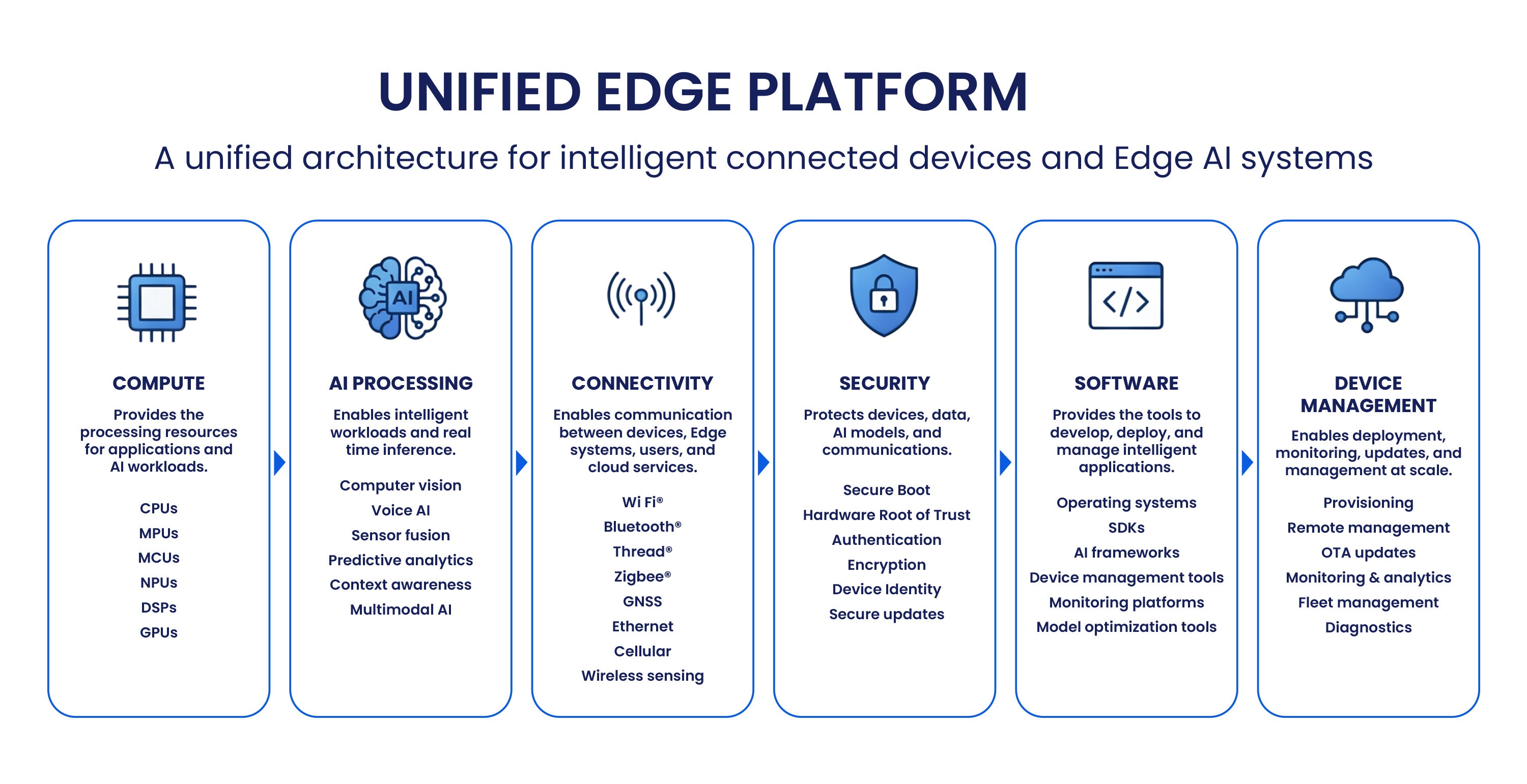
A unified Edge platform combines the core technologies required to build and deploy intelligent Edge and AIoT systems into a single, integrated ecosystem. At its foundation is a compute layer that provides the processing resources needed to run applications and AI workloads using technologies such as CPUs, MPUs, MCUs, NPUs, DSPs, and GPUs. The platform also includes AI processing capabilities that enable functions such as computer vision, voice AI, sensor fusion, predictive analytics, context awareness, and multimodal AI. Connectivity technologies—including Wi‑Fi®, Bluetooth®, Thread®, Zigbee®, GNSS, Ethernet, cellular, and wireless sensing—allow devices to communicate with users, other devices, Edge infrastructure, and cloud services. Integrated security features help protect devices, software, communications, and AI models through capabilities such as secure boot, hardware root of trust, authentication, encryption, device identity, and secure updates. Supporting these layers is a software ecosystem that includes operating systems, development tools, AI frameworks, device management platforms, monitoring solutions, and model optimization tools. Together, these technologies create a complete foundation for developing, deploying, securing, and managing intelligent Edge devices and applications.
Why is a Unified Edge Platform Different from Traditional Edge Development?
Traditional Edge development often requires engineering teams to integrate processors, AI accelerators, connectivity technologies, security frameworks, operating systems, and software tools from multiple vendors. While this approach can provide flexibility, it also increases development complexity, introduces interoperability challenges, and places a greater burden on teams to manage integration, maintenance, and lifecycle support.
A unified Edge platform takes a different approach by bringing these technologies together within a single, cohesive ecosystem. Instead of assembling and validating numerous components independently, developers can work with pre-integrated compute, AI, connectivity, security, and software resources that are designed to operate together. This reduces engineering effort, streamlines development workflows, and helps accelerate the path from concept to deployment.
By providing a consistent architecture across devices, applications, and deployment environments, unified Edge platforms also improve scalability and simplify long-term management. As intelligent connected devices become more sophisticated and AI workloads become more distributed, a unified platform helps organizations focus on building differentiated products and user experiences rather than managing underlying infrastructure.
What are the Core Characteristics of a Unified Edge Platform?
A unified Edge platform is characterized by an integrated architecture, a consistent development experience, simplified deployment, and scalable design. By bringing together hardware, software, connectivity, security, and AI within a single ecosystem, it helps reduce integration complexity and improve interoperability. Developers can leverage common tools, frameworks, and workflows across multiple device categories, making it easier to build, deploy, and manage intelligent Edge applications. This approach also supports scalability across diverse use cases and deployment environments, enabling organizations to adapt and grow without extensive redesign or reengineering.
What are the Benefits of a Unified Edge Platform
- Faster development
- Lower integration costs
- Improved reliability
- Enhanced security
- Better scalability
- Simplified lifecycle management
- Consistent deployment workflows
Common Applications of a Unified Edge Platform
Smart Home Systems
- Smart displays
- Voice assistants
- Home security
- Energy management
Industrial Automation
- Predictive maintenance
- Robotics
- Machine vision
- Quality inspection
Robotics and Physical AI
- Autonomous systems
- Environmental awareness
- Real-time decision making
Intelligent Cameras
- Object detection
- Security analytics
- Occupancy monitoring
Enterprise IoT
- Connected infrastructure
- Asset monitoring
- Device management
Healthcare Devices
- Patient monitoring
- Clinical support
- Real-time analytics
How Do Unified Edge Platforms Support Distributed Intelligence?
Modern AIoT and Edge AI systems increasingly rely on distributed intelligence , where processing, decision-making, and analytics are performed across devices, Edge infrastructure, and cloud environments. In these architectures, intelligent devices perform local sensing and AI inference in real time, connected Edge systems coordinate actions and share insights, and cloud platforms provide orchestration, analytics, model management, and long-term data processing. A unified Edge platform provides the common foundation that enables these distributed environments to work together efficiently by integrating compute, connectivity, security, software, and AI capabilities within a consistent architecture. This approach helps organizations build scalable, secure, and intelligent systems that can operate seamlessly across the device-to-edge-to-cloud continuum.
How Does Synaptics Support Unified Edge Platforms?
Synaptics advances AI-native Edge computing through a unified approach that integrates compute, AI, connectivity, security, sensing, and software within a single development ecosystem. By reducing the complexity of fragmented Edge architectures, Synaptics enables developers to build and deploy intelligent connected devices more efficiently.
Astra®
Astra is Synaptics' AI-native Edge AI platform, bringing together scalable compute solutions, Astra Machina™ technologies, adaptive AI development resources, Synaptics connectivity solutions, and ecosystem support. By unifying these capabilities within a single platform, Astra helps simplify development and accelerate the deployment of intelligent connected devices across AIoT, industrial automation, robotics, healthcare, security, and smart home applications.
Frequently Asked Questions
What technologies are typically included in a unified Edge platform?
Most platforms include processors, AI accelerators, connectivity technologies, security features, software frameworks, development tools, and device management capabilities.
How does a Unified Edge Platform support Edge AI?
It provides the compute, connectivity, security, software, and deployment infrastructure needed to build and manage intelligent Edge devices.
What industries benefit most from unified Edge platforms?
Manufacturing, robotics, healthcare, transportation, security, smart homes, retail, and enterprise IoT are among the largest adopters.
What is the difference between a unified Edge platform and a traditional embedded system?
Traditional embedded systems often require separate technologies and tools from multiple vendors. Unified Edge platforms integrate these capabilities into a cohesive ecosystem.
How do unified Edge platforms support distributed intelligence?
They provide a common architecture that enables devices, Edge systems, and cloud services to share information and coordinate actions across connected environments.
What are the benefits of an integrated architecture?
Integrated architectures reduce engineering effort, improve reliability, lower development costs, accelerate time-to-market, and simplify long-term management.
How does Astra relate to a unified Edge platform?
Astra combines compute, software, connectivity, AI development resources, and ecosystem support into an AI-native Edge AI platform for intelligent connected devices.
Key Takeaway
A unified Edge platform brings together compute, AI, connectivity, security, and software within a single ecosystem, helping organizations build, deploy, and scale intelligent connected devices more efficiently. By reducing integration complexity and enabling distributed intelligence, unified Edge platforms provide the foundation for modern AIoT and Edge AI applications.