Connected Edge
Connected Edge refers to intelligent devices and systems that combine local AI processing with network connectivity, enabling real-time decision making while remaining connected to broader digital ecosystems.

What Is Connected Edge?
Connected Edge is an architectural approach that combines local intelligence with continuous connectivity.
Rather than sending all data to the cloud for processing, Connected Edge systems perform analysis and decision making close to where data is generated while remaining connected to devices, networks, enterprise systems, and cloud services.
This approach enables devices to respond in real time while still participating in larger digital ecosystems.
Connected Edge architectures are increasingly used across:
- Industrial automation
- Robotics
- Smart homes
- Intelligent cameras
- Healthcare systems
- Smart buildings
- Transportation infrastructure
- Enterprise IoT
As AI becomes more distributed, Connected Edge serves as the bridge between local intelligence and connected ecosystems.
In simple terms:
Edge intelligence enables local decisions.
Connected Edge enables local decisions that can also coordinate with larger systems.
Why Does Connected Edge Matter?
Modern connected devices generate vast amounts of data, creating new challenges for organizations that rely on real-time insights and distributed operations. Sending all data to centralized infrastructure for processing can introduce latency, increase network costs, create scalability bottlenecks, and raise concerns about privacy and resilience. Connected Edge helps address these challenges by enabling devices to process information close to where it is generated, allowing systems to respond faster, operate more efficiently, and share only the data, insights, and actions that are needed.
Faster Response Times
Connected Edge reduces latency by processing data close to where it is generated rather than sending every request to a centralized cloud. This allows devices and applications to respond more quickly to events, making Connected Edge well suited for real-time use cases such as industrial automation, robotics, intelligent transportation, and video analytics.
Reduced Bandwidth Consumption
Connected Edge decreases network traffic by analyzing, filtering, or aggregating data locally before transmitting it elsewhere. Instead of sending continuous raw data streams, Edge systems can share only relevant events, alerts, or insights, helping organizations use available bandwidth more efficiently.
Improved Reliability
Connected Edge allows systems to continue operating even when connectivity to the cloud or central infrastructure is interrupted. By maintaining local processing capabilities, devices can support critical functions and decision-making without relying on continuous network availability.
Better Scalability
Connected Edge distributes processing across devices, gateways, and local infrastructure rather than concentrating workloads in a single location. This distributed model helps organizations support growing numbers of connected devices, applications, and data streams while maintaining performance.
Enhanced Privacy
Connected Edge can support privacy initiatives by processing sensitive information closer to where it is generated. By reducing the amount of raw data transmitted to centralized systems, organizations can limit data exposure and better support regulatory, compliance, and data sovereignty requirements.
Cloud and Enterprise Connectivity
Connected Edge combines local processing with connectivity to cloud platforms, enterprise applications, and other intelligent devices. This enables organizations to share insights, coordinate actions, and manage distributed systems across Edge and cloud environments.
How Does Connected Edge Work?
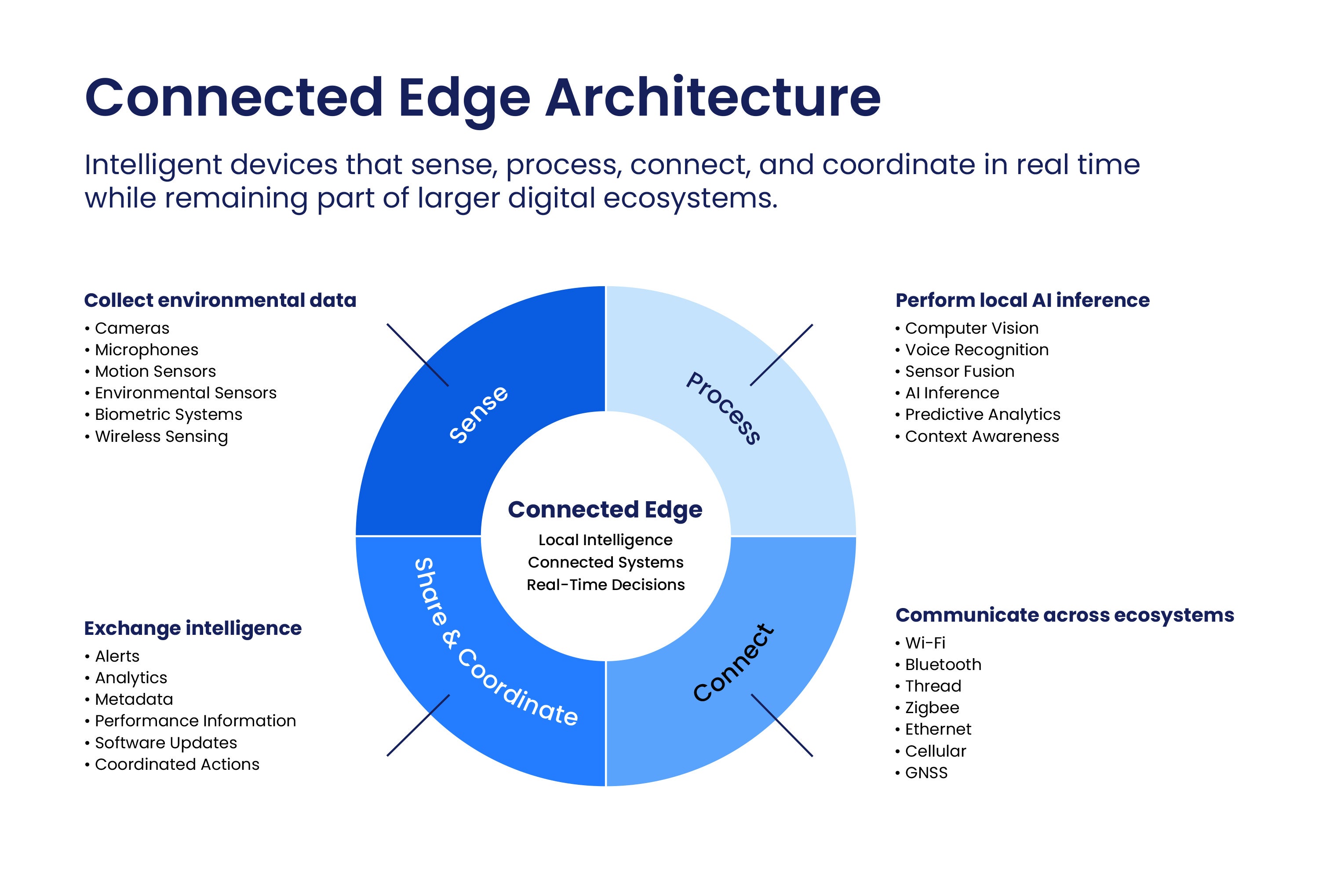
Connected Edge works by combining intelligent sensing, local processing, and continuous connectivity. Devices collect data from their environment, analyze that data close to where it is generated, and communicate insights to other devices, enterprise systems, and cloud services. This approach enables real-time decision-making while reducing latency, bandwidth usage, and dependence on centralized infrastructure.
Sense
Connected Edge systems begin by collecting information from the physical world. Intelligent devices use technologies such as cameras, microphones, motion sensors, environmental sensors, biometric systems, and wireless sensing technologies to detect events, conditions, and user interactions. This data provides the foundation for understanding what is happening in the surrounding environment.
Process
Once data is collected, Edge processors perform local analysis and decision-making. Workloads may include computer vision, voice recognition, sensor fusion, AI inference, predictive analytics, and context awareness. By processing data locally, Connected Edge systems can transform raw information into actionable intelligence without relying entirely on cloud-based resources.
Connect
Connected Edge devices remain connected to other systems through networking technologies such as Wi-Fi®, Bluetooth®, Thread®, Zigbee®, Ethernet, cellular networks, and GNSS. These connections enable devices to exchange information with other Edge devices, enterprise applications, cloud platforms, and users, creating a connected ecosystem that extends beyond a single device.
Share and Coordinate
Rather than transmitting all raw data to centralized infrastructure, Connected Edge systems typically share only the information that is relevant for broader coordination and analysis. This may include alerts, analytics, metadata, performance information, and software updates. By sharing insights instead of raw data, Connected Edge enables distributed intelligence while reducing bandwidth requirements and improving scalability.
What Are the Key Characteristics of Connected Edge?
Connected Edge combines local intelligence with continuous connectivity, allowing devices to process data, make decisions, communicate with other systems, and coordinate actions across distributed environments. Several characteristics distinguish Connected Edge architectures from traditional cloud-centric approaches.
Intelligent Sensing
Connected Edge systems continuously collect information from the physical world using technologies such as cameras, microphones, motion sensors, environmental sensors, biometric systems, and wireless sensing technologies. These inputs allow devices to understand their surroundings and generate the data needed for real-time decision-making.
Local Intelligence
Connected Edge devices analyze data close to where it is generated rather than relying exclusively on cloud-based processing. Local workloads may include computer vision, voice recognition, sensor fusion, AI inference, predictive analytics, and context awareness. This enables faster decisions while reducing dependence on network connectivity.
Continuous Connectivity
Connected Edge devices remain connected to larger digital ecosystems through technologies such as Wi-Fi®, Bluetooth®, Thread®, Zigbee®, Ethernet, cellular networks, and GNSS. Connectivity allows intelligent devices to exchange information with cloud platforms, enterprise systems, users, and other Edge devices when needed.
Distributed Intelligence
Rather than concentrating all processing in a centralized location, Connected Edge distributes intelligence across devices, gateways, local infrastructure, and cloud resources. This approach improves scalability, resilience, and responsiveness while enabling systems to operate closer to real-world events.
Selective Data Sharing
Connected Edge systems typically share only the information needed to support broader coordination. Instead of transmitting all raw data, devices can communicate alerts, analytics, metadata, performance information, and software updates. This reduces bandwidth consumption while supporting collaboration across distributed environments.
Context Awareness
Connected Edge devices can understand environmental conditions, user interactions, operational states, and other situational factors. This context awareness helps systems make more relevant decisions and adapt their behavior based on changing conditions.
Security and Privacy
Connected Edge architectures often incorporate security and privacy protections directly into the device and communication layers. By processing more data locally and transmitting only necessary information, organizations can reduce data exposure while helping support security, compliance, and data governance requirements.
Connected Edge vs. Edge Computing
Connected Edge and Edge Computing are closely related concepts, but they focus on different aspects of intelligent distributed systems.
Edge Computing
Edge Computing refers to the practice of processing data close to where it is generated rather than transmitting all information to centralized cloud infrastructure. The primary goal is to reduce latency, conserve bandwidth, improve reliability, preserve privacy, and enable faster decision-making.
Connected Edge
Connected Edge builds on the principles of Edge Computing by combining local processing with continuous connectivity and coordination. In addition to analyzing data locally, Connected Edge systems exchange information with other devices, enterprise applications, and cloud services to support broader workflows, automation, and intelligence.
Key Difference
The primary difference is scope:
- Edge Computing focuses on processing data near its source.
- Connected Edge focuses on how intelligent Edge devices communicate, coordinate, and collaborate across larger digital ecosystems.
In simple terms:
Edge Computing = Local processing
Connected Edge = Local processing + connectivity + coordination
Connected Edge and Intelligent Systems
Connected Edge is commonly used within AIoT, distributed intelligence, robotics, autonomous systems, and Physical AI deployments. In these environments, individual devices can make local decisions while remaining connected to broader systems that share information and coordinate actions.
In these environments:
- Devices perform local sensing and inference
- Connected systems coordinate actions across multiple devices
- Cloud platforms that support analytics, orchestration, and management
- Intelligent devices that perform local sensing and AI inference
Connected Edge provides the communication and coordination layer that enables these interactions.
Common Applications
Smart Homes
- Voice assistants
- Smart displays
- Home security
- Energy management
Industrial Automation
- Predictive maintenance
- Robotics coordination
- Machine vision
- Asset monitoring
Intelligent Cameras
- Object detection
- Security analytics
- Occupancy monitoring
Robotics
- Navigation
- Environmental awareness
- Fleet coordination
Healthcare
- Patient monitoring
- Connected medical devices
- Remote diagnostics
Smart Buildings
- Occupancy management
- Security systems
- HVAC optimization
- Intelligent collaboration spaces
Benefits of Connected Edge
- Faster decision-making
- Reduced bandwidth usage
- Improved reliability
- Better scalability
- Enhanced privacy
- Stronger ecosystem integration
- Support for distributed intelligence
Synaptics and Connected Edge
Connected Edge is a core element of Synaptics' vision for AI-native computing at the Edge. Synaptics develops technologies that help intelligent devices sense, process, connect, secure, and act locally while remaining connected to broader ecosystems of devices, enterprise systems, and cloud services. Together, these capabilities enable distributed intelligence across consumer, enterprise, industrial, and IoT environments.
Astra®
Astra provides AI-native Edge computing platforms that enable intelligent connected devices to perform local processing, AI inference, and real-time decision-making at the Edge. These platforms serve as the foundation for devices that combine on-device intelligence with ecosystem-wide connectivity.
Torq™ NPU
Torq NPU accelerates AI inference workloads directly on Edge devices, helping intelligent systems analyze data, recognize patterns, and make decisions locally. By enabling efficient on-device AI processing, Torq™ supports the low-latency operation required by Connected Edge applications.
SyNAP™
SyNAP provides AI software tools that simplify model optimization, deployment, and execution across Synaptics Edge AI platforms. This helps developers bring AI workloads from development to production while supporting a wide range of Connected Edge use cases.
Intelligent Connectivity and Ecosystem Integration
Connected Edge relies on more than local processing. Synaptics technologies support the connectivity, communication, and integration required for intelligent devices to exchange information with other devices, enterprise systems, and cloud platforms. This allows local intelligence to participate in larger distributed systems while maintaining responsiveness at the Edge.
Enabling Distributed Intelligence
By combining AI-native compute, AI acceleration, software tools, sensing technologies, connectivity, and security capabilities, Synaptics help enable devices that can operate intelligently on their own while coordinating with broader ecosystems. This approach supports AIoT, robotics, smart home, industrial automation, intelligent camera, healthcare, and Physical AI applications.
Frequently Asked Questions
How is Connected Edge different from Edge Computing?
Edge Computing focuses on local data processing, while Connected Edge emphasizes how intelligent Edge systems communicate and coordinate across larger ecosystems.
Does Connected Edge require cloud connectivity?
No. Connected Edge systems can continue operating locally even when cloud connectivity is unavailable, although cloud services may still provide analytics and orchestration.
What industries use Connected Edge architectures?
Manufacturing, robotics, healthcare, transportation, security, smart homes, and enterprise IoT.
How does Connected Edge support AI?
It allows AI-powered devices to process information locally while communicating insights, actions, and updates across connected systems.
How does Connected Edge enable distributed intelligence?
Connected Edge allows intelligence to be distributed across devices, Edge systems, enterprise platforms, and cloud infrastructure rather than centralized in a single location.
What types of devices use Connected Edge architectures?
Examples include intelligent cameras, robots, industrial equipment, healthcare devices, smart home products, sensors, and connected infrastructure systems.
How does Synaptics support Connected Edge?
Synaptics enables Connected Edge through Astra®, Veros™, Torq™ NPU, SyNAP™, wireless sensing technologies, and AI-native Edge computing platforms.