

While Wi-Fi 7 is rolling out and Wi-Fi 8 is in the Institute of Electrical and Electronics Engineers (IEEE) task group phase, forward-looking organizations are already considering what wireless standard comes next. Previous standards have centered on speed and reliability. Wi-Fi 9 will likely define native intelligence and sensing, providing key capabilities for product design. This Wi-Fi 9 guide explores everything you need to know about the next wireless standard. This includes integrated sensing, AI-native air interfaces and 6G convergence.
What Is Wi-Fi 9?
Wi-Fi 9 is the informal name given to the generation of wireless technology expected to follow Wi-Fi 8. The IEEE has not assigned a technical name to it yet because Wi-Fi 8 is still in development. While the IEEE has not confirmed any exact specifications for Wi-Fi 9, this standard will likely feature intelligence with integrated sensing and an AI-native platform.
The Wi-Fi Roadmap
To understand where Wi-Fi is heading, it is helpful to understand what previous standards have achieved. Wi-Fi 7 was all about speed. It solved the 8K video problem with 320 megahertz (MHz) channels and 4096-QAM. Finalized in early 2024, Wi-Fi 7 is rapidly being deployed across flagship mobile devices and enterprise access points.
The IEEE Task Group bn, working on Wi-Fi 8, has a Final Standard Approval scheduled for late 2028. They are developing a solution for ultra-high-reliability Wi-Fi. This aims to solve the industrial latency problem.
Wi-Fi 9 moves beyond speed and reliability to focus on environmental awareness and intelligent edge computing. AI-powered features are also crucial, allowing for predictive frequency management, native sensing and adaptive network optimization.
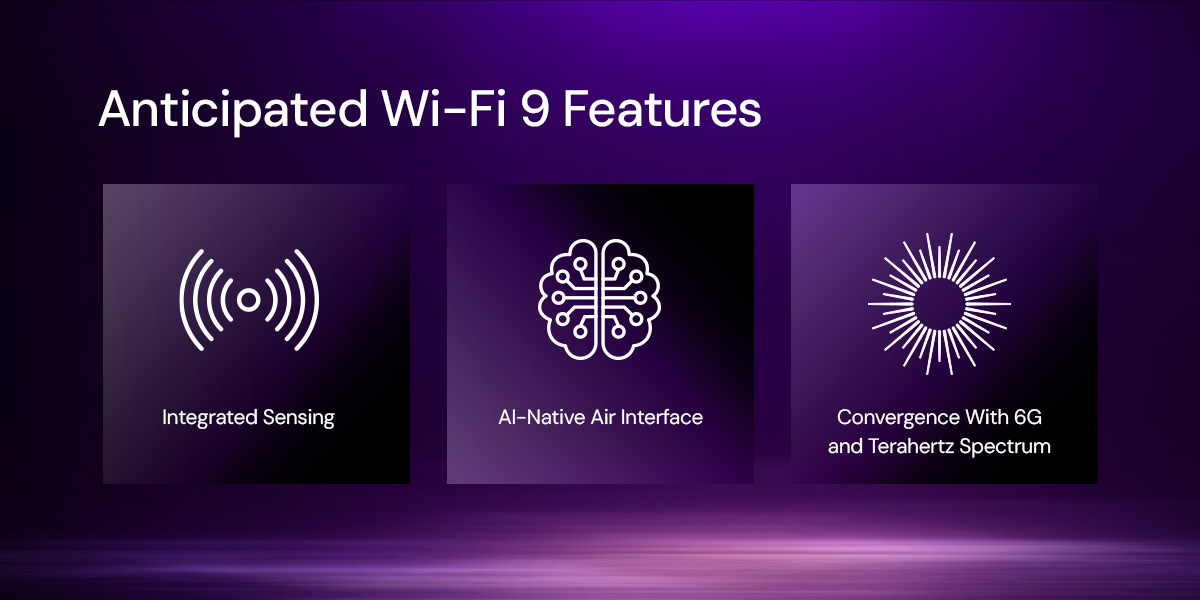
Anticipated Wi-Fi 9 Features
Let's explore some Wi-Fi 9 features and how they could work.
1. Integrated Sensing
WLAN or Wi-Fi sensing uses RF signals to detect presence, gestures and motion without using cameras. IEEE standard 802.11bf is introducing WLAN sensing now. It uses software to analyze channel state information. The key limitation is that it is proprietary, whereas Wi-Fi 9 could enable interoperability across devices from lightbulbs to thermostats.
Wi-Fi 9 could include sensing as a mandatory, native capability of the PHY layer. This means that rather than bolting software on top, products would have the capabilities built into their hardware.
There are various use cases, from smart homes to healthcare and even the automotive industry:
- Smart homes: One of the key benefits of Wi-Fi 9 for smart homes could be the ability to turn the lights on when you enter, without the need for a PIR sensor or camera. This provides a function without compromising the privacy of the homeowner.
- Healthcare: Wi-Fi 9 sensing can detect minute variations in RF signals, such as the rise and fall of a human chest. This allows for 24/7 vital sign monitoring while eliminating the need for patients to wear uncomfortable equipment. Again, no cameras would be invading privacy here.
- Industrial: Racking creates blind spots in warehouses. RF signals penetrate and wrap around racking better than light does for camera-based detection systems. This reduces the infrastructure costs of setting up multiple cameras.
- Security: Unlike cameras, RF signals cope with smoke, unlit server rooms and dusty conditions. This is useful for security monitoring. The systems also generate simple event metadata rather than a 24/7 video stream to reduce bandwidth consumption for remote monitoring sites.
2. AI-Native Air Interface
There are only a limited number of frequencies available for data to travel on. Managing 2.4, 5, 6 and 60 gigahertz (GHz) bands manually or through simple algorithms is becoming inefficient. Currently, routers wait for a packet loss before switching devices to a clearer lane. This reaction time can be too slow, causing downtime.
Wi-Fi 9's solution to this is an AI-native air interface. This is where the standard can use deep learning to predict channel interference to switch frequencies proactively.
For dense industrial environments, Wi-Fi for Internet of Things (IoT) offers a key efficiency tool. The AI-native air interface enables zero-touch network management by predicting interference and automatically switching frequencies. This is crucial for a factory with thousands of sensors to boost automated resilience and uptime.
Wi-Fi 9 applications in IoT include:
- Robotics: A robotic arm never loses connection, even if the 60 GHz path is blocked.
- Telecommunications: In bustling cities, especially during major events like concerts or sports, thousands of phones simultaneously try to connect to Wi-Fi. Simple routers cannot sort the traffic quickly enough, and crash. Wi-Fi 9 could shift people to underutilized frequencies before congestion becomes too severe, enabling seamless connectivity even in large crowds.
3. Convergence With 6G and Terahertz Spectrum
Wi-Fi 9 could align with the IMT-2030 and the development of 6G. This wireless standard could enable Multi-RAT technology. This means a device uses Wi-Fi, 5G and 6G simultaneously, so there are no delays in switching.
There is potential for a new spectrum, Terahertz, to provide incredibly fast, short-range data transfer. Frequencies would exceed 100 GHz, offering massive bandwidth, but the signal would be the biggest issue. It is so weak that humid air or a sheet of paper blocks the signal. Wi-Fi sensing could help by detecting when a device is close enough to use the terahertz link, enabling touch-and-go data transfer. This could be useful for data-docking stations or kiosks where large amounts of data need to be transferred in seconds.
Implications for Design Engineers
When considering what to expect from Wi-Fi 9, engineers should prioritize upgrading their Wi-Fi chip to ensure sensing and AI management are integrated as standard. Wi-Fi chips have to go beyond being mere data conduits to become data processors.
To minimize latency, RF data should be processed locally. This means pairing a Wi-Fi radio with a Neural Processing Unit (NPU). Edge AI is faster than uploading RF data to the cloud and also preserves privacy.
Power efficiency is also important. Continual Wi-Fi sensing drains battery life. Ensure you include architectures that support low-power sensing modes. This allows the radio to monitor the environment for triggers, such as motion, while the main processors remain in low-power mode to conserve energy.
Frequently Asked Questions About Wi-Fi 9
With the new wireless standard on the horizon, let's explore a few common questions about Wi-Fi 9:
- When is Wi-Fi 9 coming out? The Wi-Fi 9 release date is still speculative. Based on the IEEE's estimated timelines for Wi-Fi 8 arriving in 2028, Wi-Fi 9 is unlikely to arrive before then. Typically, each standard takes 3-4 years to develop and fully roll out.
- Will it be faster than Wi-Fi 7? Speed increases are likely with Wi-Fi 9, which supports Multi-RAT and access to Terahertz bands. But the main focus is shifting from raw throughput to AI-driven reliability, and Wi-Fi sensing capabilities.
- Do I need new hardware for Wi-Fi 9? The upgrade to new chipsets with dedicated NPUs is key to enabling AI-native air interfaces and sensing layers. If your product doesn't already have a chip with edge-computing capabilities, consider updating it to future-proof your tech.
Be Prepared for Wi-Fi 9 With Synaptics
Wi-Fi 9 shifts the wireless standard from connecting devices to understanding environments. Preparing for Wi-Fi 9 means your products and devices seamlessly transition and have the capabilities needed in the near future.
At Synaptics, we are the go-to partner for forward-thinking product innovators worldwide. We are continually developing our products to meet the latest demands of edge computing. Our Synaptics Connectivity series provides the high-performance wireless connectivity you need for IoT devices, while our Synaptics Astra™ AI-native compute platform provides powerful edge AI processing. Explore our Astra™ embedded processors and Synaptics Wi-Fi solutions today.