

Wireless design has reached a turning point. Every year, you’re expected to ship products that deliver better performance, faster throughput, lower latency, smoother roaming and more consistent reliability. However, the wireless environments in which your products operate are becoming more crowded, unpredictable and challenging to manage at scale.
This is why edge AI at the connectivity layer is changing wireless performance and gaining momentum. Instead of relying on static rules, devices now analyze the radio frequency (RF) environment directly on the hardware, interpreting conditions in real time and adapting instantly. It’s a shift that gives engineering teams more control, more flexibility and far stronger wireless performance, even in chaotic environments. Below, we explore how AI is changing wireless performance, the real techniques behind these improvements and what these capabilities mean for the future of your products.
Moving Intelligence to the Network Edge
Traditional cloud-based optimization is struggling to keep pace with the demands of modern wireless performance. By the time data makes a round trip to a server and back, the network environment may have already shifted. Edge AI for Wi-Fi offers a solution to this growing challenge.
With edge AI, the device itself becomes the brain, processing RF conditions locally. It analyzes AI signals, measures interference and dynamically adjusts parameters in real time. This approach provides three key benefits:
- Instant responsiveness: AI models running on the device eliminate cloud delays, allowing near-instant corrective actions.
- Greater reliability: Local intelligence allows the device to adapt before users feel performance dips.
- Better security: Keeping data on the device reduces the risk of interception or exposure.
4 Core AI Techniques for Wireless Networks
Modern wireless systems are becoming incredibly adaptive and resilient, thanks to a suite of core AI-driven improvements. Each technique addresses a real-world pain point engineers face when designing products for dense, noisy or mobile environments.
1. AI-Powered Interference Management
With so many devices competing for airtime, signals collide, degrade or weaken without warning. Traditional systems react only after the problem becomes visible. Edge AI, on the other hand, reads interference patterns as they form, adapting instantly to maintain a solid connection.
The following are key ways AI strengthens interference management at the connectivity layer:
- Real-time interference classification: AI models continuously analyze RF activity, intelligently distinguishing between sources of interference. This allows the device to respond with precision, targeting the cause of the problem, not just the symptom.
- Dynamic parameter tuning: Instead of relying on fixed thresholds, AI adjusts modulation schemes, coding rates, transmit power and retry logic in real time to maintain stable connections in changing environments.
- Smarter coexistence handling: AI helps wireless systems operate smoothly alongside other protocols by predicting conflicts before they occur and making proactive adjustments.
2. Adaptive Channel and Bandwidth Selection
Older wireless systems make reactive or surface-level decisions when choosing a channel. They detect congestion only after performance drops, leading to unnecessary hopping, inconsistent throughput and avoidable latency.
The following are key ways AI improves channel and bandwidth selection:
- Continuous spectrum assessment: AI models scan and interpret real-time RF activity across available channels, enabling the device to understand current congestion and how conditions are likely to shift.
- Predictive channel decision-making: Instead of selecting the next open channel randomly, AI forecasts which channels will deliver the most consistent performance, reducing the risk of moving into equally congested or deteriorating spectrum.
- Adaptive bandwidth optimization: AI evaluates traffic load, interference levels and application requirements to choose the ideal channel width.
3. Predictive Handoffs and Smart Roaming
Roaming becomes unreliable when devices wait too long to switch to a stronger access point. This delay causes stutters, video freezes, dropped calls and inconsistent performance.
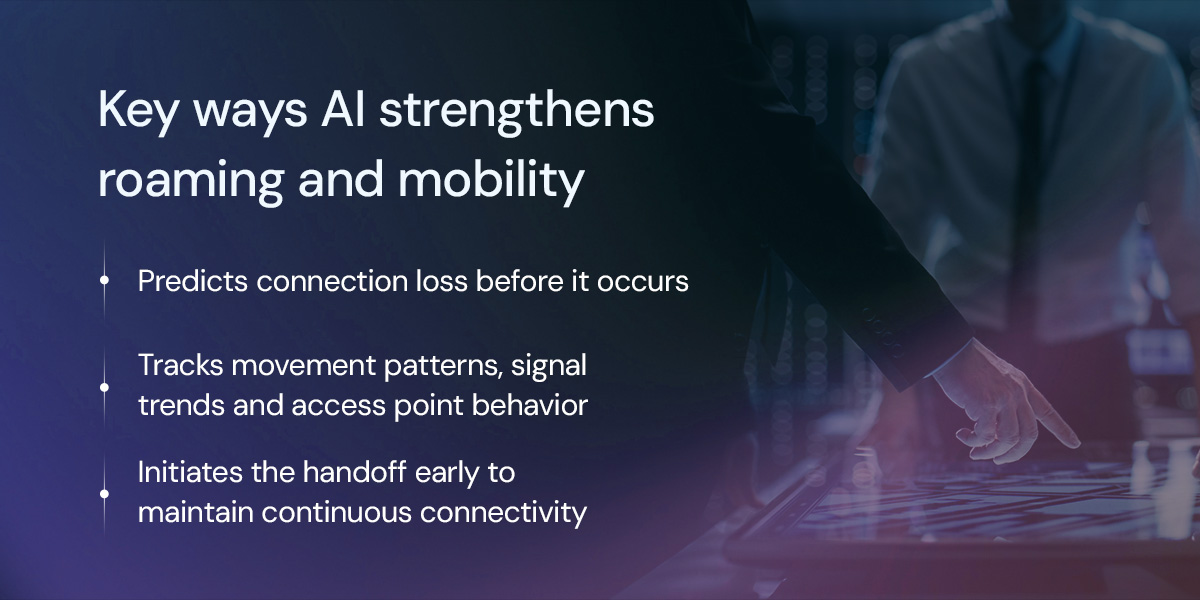
The following are key ways AI strengthens roaming and mobility:
- Predicts connection loss before it occurs: AI algorithms proactively anticipate when a connection is about to weaken or drop, giving the device time to prepare for a smooth transition.
- Tracks movement patterns, signal trends and access point behavior: AI continuously monitors these key factors to gain a comprehensive understanding of the user’s environment and predict the optimal time for a handoff.
- Initiates the handoff early to maintain connectivity: By initiating the handoff process before the connection degrades, AI ensures a seamless transition to a stronger access point, eliminating frustrating interruptions.
4. Dynamic Resource and Power Allocation
Power management is crucial, particularly in IoT devices where battery life has a substantial impact on overall product viability and reliability.
The following are key ways that AI improves resource and power management:
- Context-aware power adjustments: AI analyzes signal strength, device proximity, interference levels and traffic requirements to fine-tune transmit power dynamically, helping maintain strong connections while reducing unnecessary energy use.
- Intelligent bandwidth distribution: AI allocates more bandwidth to high-priority or latency-sensitive applications, such as video processing and navigation data, while optimizing background traffic to prevent congestion.
- Optimized wake-sleep scheduling: AI uses techniques like Target Wake Time (TWT) to plan efficient sleep intervals for IoT devices, thereby significantly improving battery life without compromising responsiveness or data accuracy.
The Impact on Next-Generation Devices
AI-enhanced connectivity doesn’t just improve RF performance. It shapes the quality, reliability and competitiveness of real-world products.
Enhanced Reliability in Industrial IoT
Industrial environments are challenging as metal structures, heavy equipment and constant RF noise create unpredictable conditions. Edge AI helps keep sensors and machinery connected through:
- Mitigating interference from moving machinery.
- Predicting congestion during peak activity.
- Maintaining stable links for automation systems.
Seamless Experiences in Smart Homes
Smart homes have evolved from a few devices to fully connected ecosystems. AI-enhanced connectivity strengthens wireless performance in smart home environments in the following ways:
- Improved device coexistence: AI identifies and predicts conflicts between protocols, such as Wi-Fi and Bluetooth, allowing devices to adjust their behavior proactively to reduce interference and improve stability.
- Consistent streaming and communication: AI manages bandwidth and channel usage in real time, keeping video calls steady, preventing buffering in 4K and UHD streams and supporting smooth playback even during peak household activity.
- Stronger support for device-heavy networks: As more smart bulbs, sensors, speakers, locks and appliances come online, AI helps distribute resources efficiently so that every device maintains reliable connectivity without overwhelming the network.
Smart Connectivity Solutions for Robotics and Drones
Robotics and drones depend on low-latency, high-integrity wireless links. Even brief interruptions cause misalignment, leading to navigation issues and lost telemetry.
Edge AI supports these devices by:
- Predicting signal loss as the robot or drone moves.
- Adjusting power and bandwidth to prioritize real-time sensor data.
- Ensuring rapid coexistence when multiple devices operate in the same area.
In environments like warehouses, farms or construction sites, these improvements enhance safety, responsiveness and stability.
Build Smarter Connections With Synaptics
As wireless environments become increasingly noisy and device expectations rise, traditional connectivity strategies are no longer sufficient. These issues slow development, affect user experience and limit the potential of otherwise well-designed devices.
From intelligent interference avoidance to real-time optimization of bandwidth, power and roaming, edge AI gives you the tools to design devices that feel faster, work smarter and perform consistently.
If you’re looking to bring these capabilities into your next design, Synaptics offers wireless connectivity solutions. With platforms engineered for real-time RF intelligence and secure on-device processing, we provide the foundation for the next generation of intelligently connected devices. Contact us today to learn how you can build stronger, smarter and more reliable connections.